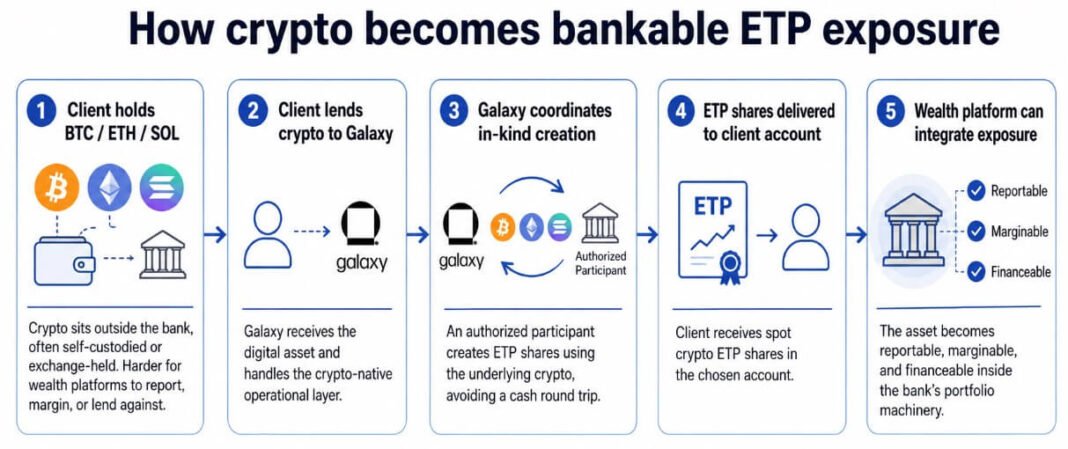
Morgan Stanley announced on June 5 that eligible wealth management clients can now lend Bitcoin, Ethereum, or Solana to Galaxy Digital and receive shares of spot crypto exchange-traded products in return.
Galaxy will coordinate an in-kind creation with an authorized participant, then deliver ETP shares directly into the client’s chosen account. Onboarding timelines that previously exceeded 4 weeks could fall by up to 75%.
For Morgan Stanley-referred clients, Galaxy has lowered the minimum transaction size from $25 million to $5 million.
US-traded spot Bitcoin ETFs recorded a historic $4.4 billion in net outflows over 13 consecutive weeks, extending into early June. Bitcoin has fallen roughly 53% from its October 2025 all-time high near $126,200 and briefly touched $60,000 this week.
Against that backdrop, Morgan Stanley’s arrangement offers wealth clients direct holding of coins that enter the bank’s portfolio machinery and become marginable, reportable, and accessible to the same infrastructure that already supports securities lending, margin accounts, and private banking.
The regulatory layer that made this possible
The SEC’s approval of in-kind creations and redemptions for crypto ETPs in July 2025 removed the central structural obstacle.
That change permitted authorized participants to create and redeem spot crypto ETP shares using underlying crypto assets, moving the plumbing closer to how commodity ETPs already function.
Galaxy can now take a client’s BTC, use it to create ETP shares in kind, and deliver those shares without a taxable sale of the underlying asset, a workflow that would have required a cash conversion round trip under the prior rules.
Morgan Stanley limits its role to referrals and client education, and Galaxy supervises onboarding and bears the crypto operational exposure.
That division keeps Morgan Stanley on the regulated-securities side of the interaction, while Galaxy bears the operational exposure to crypto.
Outside crypto wealth, previously held in self-custody or on an exchange, moves into a bankable portfolio, where it can serve as collateral for margin and integrate with reporting and lending services.
Three models for three theories
Morgan Stanley’s arrangement sits within a broader institutional divergence about which form of crypto exposure banks can safely recognize, and three models are now running in parallel.
The first is ETP collateral, which is the most bank-friendly form, since banks understand how to price, custody, margin, and liquidate a registered security. JPMorgan moved here first, accepting BlackRock’s IBIT shares as collateral for loans before expanding further.
The Morgan Stanley/Galaxy arrangement extends this model by converting crypto held outside the bank into ETP shares that slot into existing wealth-management, margin, and lending workflows.
The second model is direct crypto collateral, representing the bigger structural leap. JPMorgan planned to allow institutional clients to pledge BTC and ETH directly against loans by year-end 2025, with third-party custodians holding the pledged assets. The bank has not publicly confirmed a live product, and the status is still based on reported plans.
| Model | Bank comfort level | Main asset form | Example from article | What banks like | Main risk |
|---|---|---|---|---|---|
| ETP collateral | High | Spot Bitcoin / crypto ETP shares | Morgan Stanley/Galaxy; JPMorgan accepting IBIT collateral | Familiar securities wrapper, custody, pricing, margining | ETF outflows transmit institutional selling |
| Direct crypto collateral | Medium to low | BTC / ETH pledged directly | Reported JPMorgan BTC/ETH collateral plan | More direct use of crypto as balance-sheet collateral | Volatility, custody, margin calls, liquidation rights |
| Tokenized collateral substitution | Rising | Tokenized Treasuries, MMFs, deposits | Standard Chartered/OKX/BlackRock BUIDL; HSBC tokenized deposits | Yield-bearing, lower-volatility collateral leg | Settlement, legal, and platform interoperability risk |
If operational, it would treat BTC and ETH the way banks already treat publicly traded stocks in a margin account, with real-time valuation, haircuts, and automated margin calls.
A loan originated at 50% loan-to-value becomes a 71% LTV loan after a 30% Bitcoin drawdown. At a 50% drawdown, that same loan hits 100%, resulting in full collateral wipeout.
The $1.8 billion in forced crypto liquidations recorded on June 3 alone, the largest single-day figure since February 2026, illustrates what leverage produces in a fast market.
The third model, tokenized collateral substitution, may prove to be the most durable. Banks prefer tokenized Treasuries or money market funds as the collateral leg, while crypto stays as the traded risk asset.
On Apr. 28, OKX, BlackRock, and Standard Chartered launched a framework that allows institutional clients to post BlackRock’s BUIDL tokenized Treasury fund as yield-bearing margin collateral on OKX, with Standard Chartered serving as the first G-SIB custodian in such an arrangement.
Clients earn yield on collateral they would otherwise leave idle, and Standard Chartered handles regulated off-exchange custody, keeping assets segregated from the exchange’s own holdings.
What banks are actually building
Standard Chartered’s off-exchange model with OKX means crypto-native trading venues need a regulated G-SIB wrapper to attract the most cautious institutional capital.
BNY is building its digital asset platform by combining custody, collateral management, financing, payments, and 24/7 liquidity rails, positioning it as the infrastructure substrate on which crypto lending and tokenized asset markets will run.
Citi has framed its role around settlement, custody of stablecoin reserves, and crypto ETF custody services, claiming the plumbing.
Every major bank is competing to control the wrapper, the custodian, the collateral agent, or the servicing infrastructure through which Bitcoin flows.
Two paths through the same plumbing
In the bull case, regulatory clarity and stronger custody controls normalize the use of BTC and ETH as pledged collateral for institutional borrowers.
Citi’s June 2026 tokenization report puts global tokenized assets at roughly $17 billion today, with a 2030 bull-case forecast of $8.2 trillion.
If that trajectory holds, crypto collateral becomes a routine feature of bank lending, tokenized Treasuries grow as the preferred institutional margin asset, and Bitcoin becomes more useful as a balance-sheet instrument.
The plumbing that Morgan Stanley and Galaxy are assembling gets extended across private banking at scale, pulling self-custodied wealth into managed portfolios where it can be financed, reported, and deployed.
In the bear case, volatility and operational risk keep banks anchored to the ETP wrapper. Direct Bitcoin collateral programs stay narrowly eligible and high-haircut, with limited reach beyond a narrow institutional base.
Banks lean on tokenized Treasuries and deposits, with HSBC expanding its tokenized deposit service to US clients in April 2026, enabling 24/7 on-chain fund movement without public-chain settlement risk, while raw BTC lending remains confined to a small set of crypto-native lenders and hedge funds.
Bitcoin ETF outflows become a recurring feature, since the regulated wrapper attracts capital that also leaves through the same door when sentiment shifts.
The leverage loop
Neither scenario eliminates the structural consequence of collateralization itself.
Galaxy Research estimated that crypto-collateralized lending reached $73.59 billion in the third quarter of 2025, split among DeFi lending (55.7%), CeFi (33.1%), and crypto-collateralized stablecoins (11.2%).
As banks expand from ETP collateral toward direct BTC and ETH lending, more of Bitcoin’s price behavior will reflect institutional deleveraging cycles.
The $4.4 billion in spot ETF outflows that pushed Bitcoin below $60,000 this week show how quickly regulated wrappers can transmit institutional selling. Add direct crypto-backed loan margin calls to that mechanism, and drawdowns carry more forced selling than the market has historically processed.
Morgan Stanley’s arrangement with Galaxy is a wealth-management funnel: outside crypto wealth enters the bank’s portfolio machinery, becomes financeable and reportable, and becomes more correlated with whatever causes institutional investors to reduce risk.
Bitcoin adoption becomes integrated into the same collateral loops that govern every other asset class, with all the structural upside and deleveraging exposure that entails.