SpaceX shares rose in early market trading Monday, extending gains from its record IPO debut after Elon Musk said the company could reach $1 trillion in annual revenue by the end of the decade.
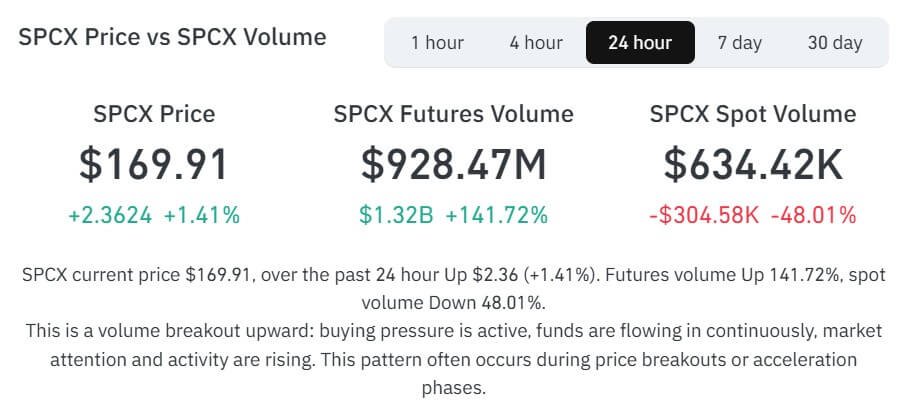
Yahoo Finance data show the stock traded near $170, up about 6% from Friday’s close.
The move followed a strong first session in which SpaceX priced its initial public offering at $135 a share, opened at $150, and closed at $161.11, giving the company a market value of about $2.2 trillion.
The rally also spilled into crypto-linked derivatives tied to the stock. CoinGlass data show SpaceX futures volume climbed 140% to about $930 million, while open interest rose above $540 million.
The early market advance added fresh momentum to one of the most closely watched listings in years, underlining investor appetite for exposure to Musk’s rocket, satellite, and artificial intelligence company after the largest IPO on record.
Retail fuels SpaceX’s record IPO debut
SpaceX raised $75 billion on its first day of trading, making it the largest IPO on record and immediately placing the rocket, satellite, and artificial intelligence company among the most valuable publicly traded companies in the US.
The company’s market value of over $2 trillion put it behind Amazon, valued at about $2.54 trillion, and ahead of Broadcom, valued at about $1.81 trillion.
Available data shows that retail investors played a central role in that debut.
Vanda Research data shows that individual investors bought a net $93.8 million of SpaceX shares on Friday, the largest single-day net retail purchase for any IPO on record.
Moreover, SpaceX accounted for about 4% of all single-stock retail turnover that day, with net purchases more than 3.5 times those of Nvidia, the next most purchased stock.
Meanwhile, the listing also spilled into crypto markets, where traders used tokenized equity products and derivatives to gain exposure to the stock. This is particularly notable, given the challenges that marked the first trading day on some crypto trading platforms, such as Binance.
Still, CryptoQuant data showed strong activity across platforms that listed SpaceX-linked instruments. On Gate.com, trading volume for the tokenized SPCX ticker exceeded $100 million on its first day, compared with about $4 million for Circle and $3.5 million for Tesla on the same venue.
Equity-linked tokens on Gate.com typically generate daily volumes between $10 million and $25 million across the assets shown in the platform’s data. SpaceX’s first-day activity stood well above that range, showing the scale of demand among crypto-native traders.
The activity suggests tokenized equities are becoming a more visible outlet for major stock-market events. These products remain small compared with traditional equity markets, and their regulatory treatment varies by jurisdiction.
Still, the SpaceX debut showed that crypto traders are willing to use on-chain or exchange-based instruments to gain exposure to high-profile public companies without leaving digital asset venues.
Musk stretches the growth case
SpaceX’s rally gained further momentum after Musk posted on X over the weekend that the firm could generate $1 trillion in annual revenue by 2030. He added that he would be surprised if the company failed to exceed that level by 2031.
The projection gave investors a new benchmark for a stock already trading at one of the richest valuations in the public market. SpaceX reported about $18.7 billion in revenue in 2025, meaning Musk’s target would require revenue to increase more than 50-fold in roughly five years.
That forecast also sits well above some of the most optimistic Wall Street estimates. Morgan Stanley projects about $330 billion in revenue by 2030, meaning Musk’s figure is roughly three times that estimate.
Meanwhile, Brett Winton, chief futurist at Ark Invest, has taken a more aggressive long-term view, saying Starlink and Starshield could generate more than $1 trillion in excess cash through 2035 while reaching $400 billion in annualized earnings.
The wide gap between current revenue and those projections helps explain the debate around SpaceX’s valuation.
The company’s revenue base is large for an aerospace business, but still small compared with the market value now attached to the stock. Its 2025 revenue marked strong growth from the previous year, while first-quarter 2026 revenue came in around $4.69 billion.
The company, however, remained in the red as spending increased.
This means that investors backing the stock are betting that several businesses can scale at once. Starlink, SpaceX’s satellite broadband network, is the company’s largest near-term revenue driver. It has become a meaningful source of recurring sales and gives SpaceX a global consumer and enterprise product outside traditional launch services.
Starshield, its government-focused satellite communications unit, has also become part of the bullish case as demand for secure connectivity grows among defense and public-sector customers.
Starship carries the more speculative upside. The launch system is designed to reduce the cost of reaching orbit and support larger commercial, government, and scientific missions. SpaceX has framed it as central to future markets in space logistics, lunar operations, Mars development, and other forms of transport.
The company has also broadened its pitch around artificial intelligence, telecommunications, and space infrastructure.
Its prospectus placed the total addressable market for those ambitions at up to $28.5 trillion, a figure that includes several industries still in their early stages of development.
Those projections help explain the intensity of demand around the IPO. They also show how much of SpaceX’s valuation depends on businesses that must scale quickly, absorb heavy investment, and avoid major technical or regulatory setbacks.
Scrutiny emerges around SpaceX’s valuation
Meanwhile, SpaceX’s market momentum has also drawn warnings from analysts who say its valuation leaves little room for slower growth, higher costs, or delays in its major projects.
CFRA analysts cited SpaceX’s demanding growth assumptions, elevated valuation, and heavy capital needs as key reasons for their cautious view.
Those costs are already rising. SpaceX reported $10.1 billion in capital expenditures for the three months ended March, compared with $4.1 billion a year earlier. The increase reflected spending on artificial intelligence infrastructure, Starship development, and other long-term projects.
At the same time, profitability remains another pressure point. The company lost nearly $5 billion in 2025, while accumulated losses over the past several years are estimated at $50 billion.
SpaceX also warned in its prospectus that it may never become profitable, a disclosure that underlines how much spending may still be required before its biggest bets mature.
Henrik Zeberg, a macro analyst at Swissblock, said the market is treating SpaceX as one of the world’s most valuable companies despite its losses.
He compared the valuation with past periods of market excess and argued that investors are paying ahead for the earnings power the company has yet to prove.
According to him:
“There is no doubt! We have the largest Bubble ever. And it will burst. Not yet. Expect surge into final top…. But soon!”
Nonetheless, Wall Street’s early targets show little agreement on where the stock should trade.
Loop Capital has the highest target at $349, followed by Baird at $320 and Bernstein at $310. Oppenheimer set its target at $190, while New Street Research is at $165.
The average sits near $267, but the wide range reflects sharply different views on SpaceX’s future revenue, margins, and market opportunity.
To sustain the rally, SpaceX will need to show that its largest businesses can grow fast enough to support the price investors are paying. The market will be looking for updates on Starlink growth, Starship progress, government contracts, AI-related spending, and any sign that revenue is moving closer to Musk’s $1 trillion target.
For now, investors are paying a premium for access to a company that was out of reach in public markets for years. That premium could remain intact if SpaceX keeps expanding quickly, but it also leaves the stock exposed if costs rise faster than expected or its path to profitability takes longer than the market currently assumes.